


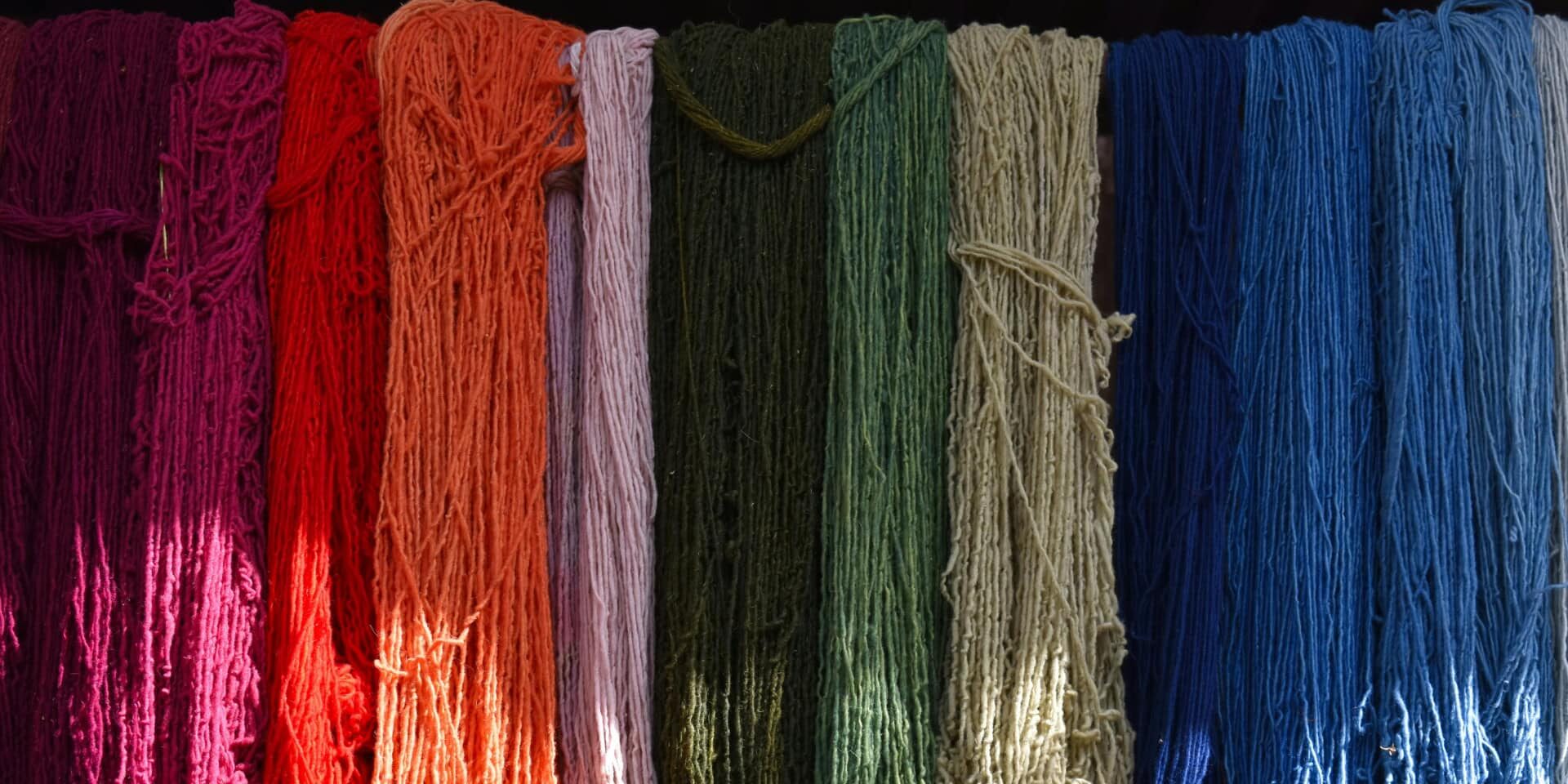
For decades, the textile industry has chased color standardization at the expense of raw material longevity. Industrial chemistry, based on acid baths at temperatures close to boiling, has imposed an invisible compromise: to obtain a flat and perfectly repeatable color, noble protein fibers are subjected to thermal stress that inevitably degrades their keratin. The rediscovery of vat dyeing through fermentation represents a rupture of this paradigm today. This is not a nostalgic return to the past, but a bio-technological choice that prioritizes fiber health over the speed of industrial production cycles.
The Thermodynamics of Color: The 35°C Threshold
The quality of a premium yarn lies in its structural integrity. Bio-chemical fermentation operates in a regime of “thermal calm” that never exceeds 30-35°C. While conventional dyeing attacks the cuticle to force the penetration of synthetic pigments, fermentation utilizes a living bacterial colony to reduce the pigment into a water-soluble (leuco) state.
In this state, the color penetrates the cortex via osmosis, almost by natural affinity. For fine-micron fibers such as Cashmere or extra-fine Merino, the difference is structural: the fiber does not undergo the mechanical stress of boiling, keeping its scales intact, elastic, and with the natural tactile silkiness of the raw material.
pH Balance and Mechanical Resilience
The stability of high-level knitwear depends on alkalinity management. While classic industrial processes can alter the isoelectric point of wool, modern fermentation (based on organic reduction protocols) allows the bath to be stabilized within a safety window between pH 9 and 9.5.
- Pilling Prevention: A fiber that is not hollowed out of its protein component by extreme heat retains superior molecular cohesion. This resilience fights pilling at the root: the fiber does not weaken, limiting breakage and the subsequent migration toward the surface that generates unsightly fuzz.
- Bulk Conservation: On hollow fibers like Alpaca, this process preserves natural airiness. The yarn does not suffer the flattening typical of massive finishing treatments, maintaining that elastic softness that defines the thermal value of the finished garment.
Atmospheric Oxidation and Chromatic Depth
In fermentation, color is not the result of an instantaneous chemical reaction, but of an encounter with oxygen. The color shift occurs at the moment the fiber is extracted from the vat and “breathes.” This step guarantees a saturation that is never superficial or static; the color seems to be born from within the fiber, giving the knitwear a visual depth and light refraction that synthetic pigments cannot replicate.
From a technical perspective, this “living” quality of the color requires constant physical manipulation during oxidation to ensure chromatic homogeneity even in critical areas, such as seams and linking joins (rimaglio), where the stitch density is higher.
Sustainability as a Parameter of Durability
Beyond compliance with international protocols such as GOTS or ZDHC, fermentation shifts the sustainability debate toward the concept of longevity. By eliminating aggressive chemical reducers (such as sodium hydrosulfite) in favor of organic catalysts, the process not only respects the ecosystem but also yields a mechanically stronger artifact.
A sweater dyed through fermentation is a product designed to withstand the test of time, preserving its original thermal and tactile properties. In this balance between bio-chemical rigor and biological patience, excellence in knitwear finds its primary function: to be a lasting investment, founded on the scientific conservation of natural matter.